Showing posts with label Structure. Show all posts

Saturday, July 10, 2010

Career As a Transportation Engineer

Transport engineering is a sub domain of civil engineering and it aims at designing and constructing efficient and comfortable means of transport for the public. It takes into account factors like traffic engineering, trip generation, urban planning to design such structures which can manage traffic and ensures smooth and hassle free travel for the public. There is a rapid increase in number of automobiles on road and hence accident rate has also increased drastically. So, the need of the hour is to design such infrastructure which can aid in lowering accident rates.

Career As a Transportation Engineer


Nature of Work

Being in a job of civil engineering domain, a transportation engineer is supposed to look after every aspect of designing, drafting and realizing transportation infrastructure like roads, flyovers, roundabouts etc. first of all a design pattern is laid out and its feasibility is checked on various parameters. Each idea which is conceived may not be feasible under realistic domains. So it is job of transportation engineer to check feasibility of such projects.

While working on large projects a transportation engineer has to coordinate with large number of people who are involved in different works. So it is mandatory that he should have good communication skills in order to manage everything well. Job of a transportation engineer can be tiring sometimes as you have to be on site for long hours. So one needs to be physically fit and healthy to take on all the hardships associated with this work.

Educational Qualifications

Being an engineering discipline, science background is mandatory to pursue a career in transportation engineering. You need to have a logical thinking aptitude and a calculative mind. Transportation engineer needs to design and draft blueprints for large infrastructures. So knowledge of engineering drawing is also required to perform our job efficiently. Many universities and colleges provide bachelor's and associate degree in this domain. You can take up this course individually or as a sub discipline of civil engineering.

Transportation engineering provides bright career opportunities for those who want to build efficient transportation system for their country and help common people to have a hassle free traveling experience.

A career as a transportation engineer opens doors to enormous career opportunities. It will help you to create dynamic and robust infrastructure for comfortable travel of public. Visit official state university website to get more details about this profession. You can also check articles by eminent writer Bhupendra Dwivedi there.

Article Source: http://EzineArticles.com/?expert=Bhupendra_Dwivedi

Tuesday, June 29, 2010

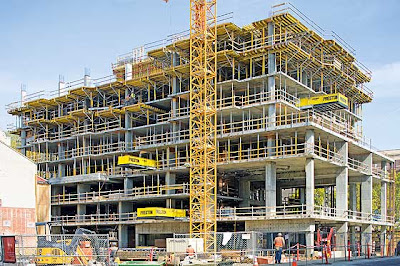
Quality and Safety Control in Construction

A variety of different organizations are possible for quality and safety control during construction. One common model is to have a group responsible for quality assurance and another group primarily responsible for safety within an organization.
Quality and Safety Control in Construction
In large organizations, departments dedicated to quality assurance and to safety might assign specific individuals to assume responsibility for these functions on particular projects. For smaller projects, the project manager or an assistant might assume these and other responsibilities. In either case, insuring safe and quality construction is a concern of the project manager in overall charge of the project in addition to the concerns of personnel, cost, time and other management issues.

Inspectors and quality assurance personnel will be involved in a project to represent a variety of different organizations. Each of the parties directly concerned with the project may have their own quality and safety inspectors, including the owner, the engineer/architect, and the various constructor firms. These inspectors may be contractors from specialized quality assurance organizations. In addition to on-site inspections, samples of materials will commonly be tested by specialized laboratories to insure compliance. Inspectors to insure compliance with regulatory requirements will also be involved. Common examples are inspectors for the local government’s building department, for environmental agencies, and for occupational health and safety agencies.
The US Occupational Safety and Health Administration (OSHA) routinely conducts site visits of work places in conjunction with approved state inspection agencies. OSHA inspectors are required by law to issue citations for all standard violations observed. Safety standards prescribe a variety of mechanical safeguards and procedures; for example, ladder safety is covered by over 140 regulations. In cases of extreme non-compliance with standards, OSHA inspectors can stop work on a project. However, only a small fraction of construction sites are visited by OSHA inspectors and most construction site accidents are not caused by violations of existing standards. As a result, safety is largely the responsibility of the managers on site rather than that of public inspectors.
While the multitude of participants involved in the construction process require the services of inspectors, it cannot be emphasized too strongly that inspectors are only a formal check on quality control. Quality control should be a primary objective for all the members of a project team. Managers should take responsibility for maintaining and improving quality control. Employee participation in quality control should be sought and rewarded, including the introduction of new ideas. Most important of all, quality improvement can serve as a catalyst for improved productivity. By suggesting new work methods, by avoiding rework, and by avoiding long term problems, good quality control can pay for itself. Owners should promote good quality control and seek out contractors who maintain such standards.
In addition to the various organizational bodies involved in quality control, issues of quality control arise in virtually all the functional areas of construction activities. For example, insuring accurate and useful information is an important part of maintaining quality performance. Other aspects of quality control include document control (including changes during the construction process), procurement, field inspection and testing, and final checkout of the facility.

Sunday, June 27, 2010

Building Codes

Building codes are a set of rules that must be followed to satisfy the minimum acceptable levels of safety for buildings and non-building structures. The objective of building codes is to ensure the health, safety and protection of the public when it comes to the construction and occupancy of buildings. Building codes are determined by appropriate authorities in different areas and may vary widely from country to country.
Introduction to Building Codes

Many countries have national building codes, developed by government agencies and applied to all building and construction work across the country. Many local jurisdictions have developed their own building codes. In America, New York and Chicago are the only two cities to use their own building codes.

Building codes are usually applied to the engineers and architects designing the building. They also serve as guidelines for safety inspectors. Others who use building codes include manufacturers of building material, insurance companies, real estate developers and tenants.

Building codes stipulate details of the construction and maintenance of a building or construction. These include fire safety rules: safety exits in buildings, limitations regarding how far a fire should spread and the provision of adequate fire fighting equipment. There are also structural rules; buildings need to be strong enough to resist internal and external forces without collapsing. Building codes also cover health stipulations such as adequate air circulation, washrooms and plumbing facilities.

Building codes can makes sure that proper noise limitations are set in place to protect occupants from noise pollution through walls and windows. There may also be special provisions to ensure that disabled people have proper access to and throughout the property. Anyone who builds a construction and fails to adhere to the proper building codes is liable to very severe penalties.

Saturday, June 26, 2010

Construction Cost Estimates

Construction cost constitutes only a fraction, though a substantial fraction, of the total project cost. However, it is the part of the cost under the control of the construction project manager. The required levels of accuracy of construction cost estimates vary at different stages of project development, ranging from ball park figures in the early stage to fairly reliable figures for budget control prior to construction. Since design decisions made at the beginning stage of a project life cycle are more tentative than those made at a later stage, the cost estimates made at the earlier stage are expected to be less accurate. Generally, the accuracy of a cost estimate will reflect the information available at the time of estimation.
Construction Cost Estimates

Construction cost estimates may be viewed from different perspectives because of different institutional requirements. In spite of the many types of cost estimates used at different stages of a project, cost estimates can best be classified into three major categories according to their functions. A construction cost estimate serves one of the three basic functions: design, bid and control. For establishing the financing of a project, either a design estimate or a bid estimate is used.

1. Design Estimates
For the owner or its designated design professionals, the types of cost estimates encountered run parallel with the planning and design as follows:

* Screening estimates (or order of magnitude estimates)
* Preliminary estimates (or conceptual estimates)
* Detailed estimates (or definitive estimates* Engineer’s estimates based on plans and specifications

For each of these different estimates, the amount of design information available typically increases.

2. Bid Estimates
For the contractor, a bid estimate submitted to the owner either for competitive bidding or negotiation consists of direct construction cost including field supervision, plus a mark up to cover general overhead and profits. The direct cost of construction for bid estimates is usually derived from a combination of the following approaches.

* Subcontractor quotations
* Quantity takeoffs
* Construction procedures.
3. Control Estimates
For monitoring the project during construction, a control estimate is derived from available information to establish:

* Budget estimate for financing
* Budgeted cost after contracting but prior to construction
* Estimated cost to completion during the progress of construction.

Friday, June 11, 2010

Industrialised Building System

What is IBS System in construction?


INDUSTRIALISED BUILDING SYSTEM IN MALAYSIA

Industrialized Building System is an alternative approach of construction that will definitely change the scenario of the current local construction industry towards a systematically approach of mass production of construction materials. Prefabricated components of buildings which are conceived, planned, fabricated from factories will be transported and erected on site. With this method, the process would involve planning; management and sustained improvement of the production process to eliminate waste and ensure the right components are produced and delivered at the right time, in the right order and without defect. In this respect, the construction industry has a great deal to learn from the manufacturing sectors that have long been emphasizing on quality and minimising defects. IBS will definitely among others reduce unskilled workers in the country, less wastage, less volume of building materials, increased site cleanliness and better quality control.


Material used in IBS System ;

1) Pre-cast Concrete Framing, Panel and Box systems
2) Steel Formwork Systems
3) Steel Framing Systems
4) Prefabricated Timber Framing Systems
5) Block Work Systems

Benefit using IBS System
The Industrialised Building Systems (IBS) promises elevated levels of expertise throughout the industry, from manufacturers, installers, engineers, planners, designers, and developers. The benefits of IBS are numerous and far reaching. Reduced construction time, better site management, reduced wastage are but a few of these benefits, that will ultimately produce better products for the population

IBS project in Malaysia.
IBS is not new in Malaysia and have been around since the early sixties. The first pilot project was initiated by the Government and it was along Jalan Pekeliling which involved 3,000 units of low cost flats and 40 shop lots. However, developments in IBS after that failed to gain support from the industry and consumers. From a survey done by CIDB on 2003, it was found that the percentage usage of IBS in the local construction industry is only at a mere 15%. However, several major world class developers in Malaysia have used some percentage of IBS in their projects. Several projects that use IBS can be seen as follows. 

  • KLIA
  • Government Quarters in Putrajaya
  • Petronas Twin Towers
  • KL Central 
Among the reasons that have made IBS not very popular with the developers would be the abundance of cheap foreign labours in the country. Currently there are about 250,000 workers in the construction industry. The Government’s effort to reduce the foreign workers to not more than 15 percent of the country’s labour force in the next five years would be an impetus for the local developers to use IBS. By using a superior construction technology that requires highly skilled workers, the dependence on foreign workers would significantly be reduced.

Wednesday, June 9, 2010

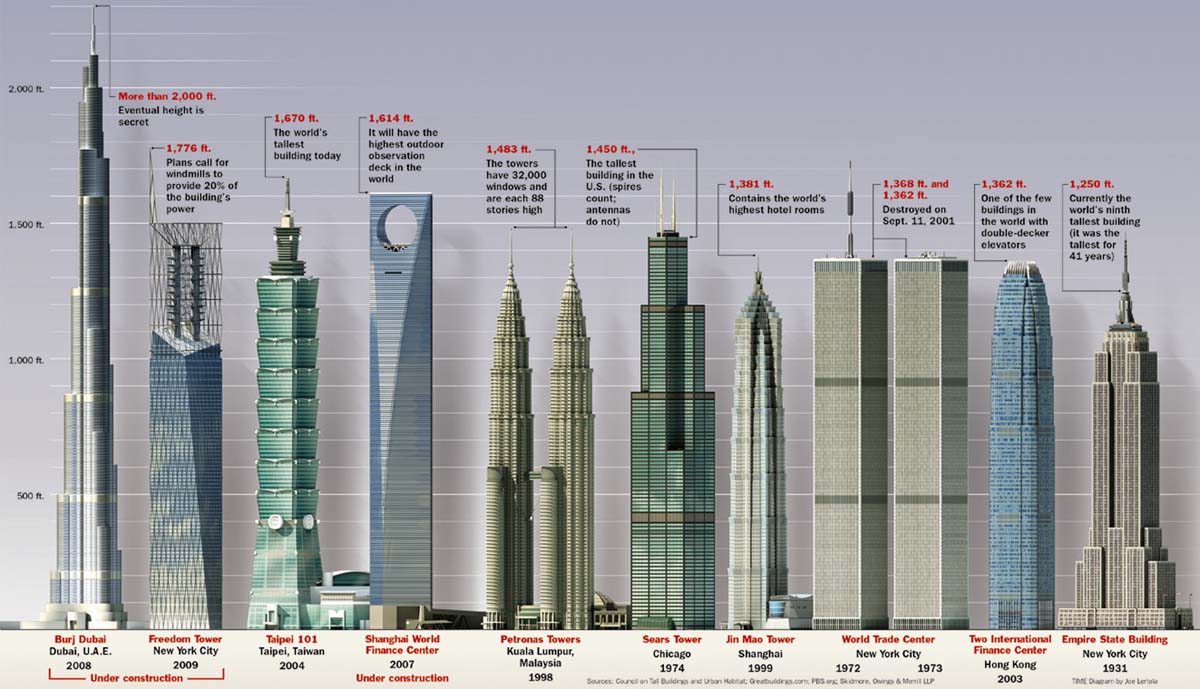
Tallest Buildings In The World

The Tallest Buildings in the World
Click Image for Larger View


When speaking of the tallest buildings in the world, it is important to specify exactly what is being measured. Listers must decide if the building is to be measured from sidewalk level or below, whether or not TV towers or masts are included, and whether an antenna, flagpole, or spire should count. A building is considered to differ from a tower in its primary use, being designed for residential, business, manufacturing, or mixed use, whereas a tower is not.