Showing posts with label Building. Show all posts

Wednesday, July 7, 2010

Various Types of Engineering

An engineer has become an increasingly important factor of our fast growing society. Long gone was the time when two or three types of engineering were the basis of technical successes. There are about 200 types which have evolved and are benefiting the society at large. A few emerging potential fields include chemical, civil, electrical, Management, Sciences, Geotechnical and Mechanical Engineering. All these fields, though different, are interlinked and are of great help to one another. For instance, one of the greatest inventions of the 20th century was the Computer. It was invented by a civil engineer back in 1941 to help his geotechnical engineer friend. Till this date, the computer is still improved by software and computer engineers.

Various Types of Engineering
The various types of have given a wide variety of options to all those students who wish to pursue engineering as a career. It has opened new fields. A student can now enter engineering keeping his or her own interest in mind, and further down the line can pursue a job that they always dreamed of doing or are the best at doing.

Chemical engineering has secondary branches to it. Agriculture, Biosystem, Environmental, Food, Forestry, Material, Plastic and Water Resource are a few to name. People living in the modern world are not very much aware of the wonders chemical engineering and its sub branches are providing to us. It has changed the entire agricultural system, the environment in which we live, and practically everything around us.

Civil engineering deals with building and construction, which partly includes Architectural as well, whereas Electrical focuses more towards Communications, Computer, Electromechanical, Electronic and Software engineering. Eng Management involves Industrial, Manufacture, Integrated, Unified, Production and Systems Engineering. Engineers belonging to Integrated and Unified Engineering are the ones who study main principles like mechanical, civil, chemical and electrical in general, and find the jobs accordingly in the industry.

One would be amazed to know that Eng Sciences included interlinked subjects such as Chemistry, Engineering, Mathematics and Physics. Students who have studied biology previously, and would like to become an engineer eventually, those students might find this field very interesting.

Those students who are willing to become geotechnical engineers have an option of selecting a special area of engineering in this particular field. For instance, Gas Engineering, Geological Engineering, Geomatics Engineering, Metallurgical Engineering, Mineral, Mining, oil and Petroleum Engineering. Geomatics engineers collect; display and analyze data about the Earth's surface and its gravity fields for uses such as mapping, legal boundary delineation, navigation and monitoring changes in the environment.

The most commonly adopted field worldwide is Mechanical Engineering. Its sub branches include Aerospace, Automotive, Biomedical and Naval Engineering. When thinking about popular types of engineering, aerospace engineering usually comes to mind. Aerospace is the specialty in which planes, helicopters, missiles, satellites, and spacecraft are designed, created, and tested.

The above will give an idea to the student to select a particular field of his own interest. Whichever field one must choose, it should be by choice not by force, or else the results will not be worth the effort put in studying.

Article Source: http://EzineArticles.com/?expert=Connor_R_Sullivan

Monday, June 28, 2010

An Introduction to Polycarboxylates Concrete Admixtures

Concrete Admixture is one ingredient of concrete that is added to the mix before or during mixing to modify concrete properties. Concrete admixtures are used to modify the properties of fresh and hardened concrete in order to achieve the desired objectives or purpose of the concrete mixture. It is also used for economic purpose when admixture allows reduction of concrete ingredients proportions or permits saving in construction practices. Concrete admixtures have their history for hundreds of years. The latest generation is polycarboxylates or polymer based admixture.

An Introduction to Polycarboxylates Concrete Admixtures


Polycarboxylates or polymer based concrete admixtures are High Range Water Reducing admixture (HRWR) or we can also say “Ultra” High Range Water Reducer. Used at low dosage, polycarboxylates admixtures still can reduce water as much as high dosage of conventional admixtures.Used at higher dosage, polycarboxylates admixtures can produce Self Compacting Concrete SCC (concrete with very high flowability but still with good cohesion). Because of their strong water reduction capacity, they are particularly designed for production of High Strength Concrete.Polycarboxylates HRWR mode of action is based on steric hindrance, this means particle separation due to long polymer molecules.

Polycarboxylates or polymer basedadmixtures like any newest generation admixtures are expensive products compared to traditional admixtures (Melamine, Naphtalene or lignosulfonates based) but their performances (even at low dosage rate) can allow cement reduction which could make the mix more cost effective.For lower grades of concrete (lower than 40 MPa on cylinder samples), conventional admixtures are still generally the best solution (especially economically). Use of Polycarboxylate admixturesin RMC (ready-mix-concrete) is normally less required than in Precast concrete because of generally lower concrete grades. This admixture type is very suitable for underwater anti-washout concrete.

Sunday, June 27, 2010

Building Codes

Building codes are a set of rules that must be followed to satisfy the minimum acceptable levels of safety for buildings and non-building structures. The objective of building codes is to ensure the health, safety and protection of the public when it comes to the construction and occupancy of buildings. Building codes are determined by appropriate authorities in different areas and may vary widely from country to country.
Introduction to Building Codes

Many countries have national building codes, developed by government agencies and applied to all building and construction work across the country. Many local jurisdictions have developed their own building codes. In America, New York and Chicago are the only two cities to use their own building codes.

Building codes are usually applied to the engineers and architects designing the building. They also serve as guidelines for safety inspectors. Others who use building codes include manufacturers of building material, insurance companies, real estate developers and tenants.

Building codes stipulate details of the construction and maintenance of a building or construction. These include fire safety rules: safety exits in buildings, limitations regarding how far a fire should spread and the provision of adequate fire fighting equipment. There are also structural rules; buildings need to be strong enough to resist internal and external forces without collapsing. Building codes also cover health stipulations such as adequate air circulation, washrooms and plumbing facilities.

Building codes can makes sure that proper noise limitations are set in place to protect occupants from noise pollution through walls and windows. There may also be special provisions to ensure that disabled people have proper access to and throughout the property. Anyone who builds a construction and fails to adhere to the proper building codes is liable to very severe penalties.

Sunday, June 13, 2010

Eurocodes

Eurocode Review Detail Discussion


Eurocode (also known as EN Eurocode or EC) is a set of pan-European model building codes developed by the European Committee for Standardisation.

The EN Eurocode is organised in 57 parts, each part published as a separate European Standard. By 2002, ten Eurocodes have been developed and published:

* EN 1990: (Eurocode 0 ) Basis of structural design
* EN 1991: (Eurocode 1 ) Actions on structures
* EN 1992: (Eurocode 2 ) Design of concrete structures
* EN 1993: (Eurocode 3 ) Design of steel structures
* EN 1994: (Eurocode 4 ) Design of composite steel and concrete structures
* EN 1995: (Eurocode 5 ) Design of timber structures
* EN 1996: (Eurocode 6 ) Design of masonry structures
* EN 1997: (Eurocode 7 ) Geotechnical design
* EN 1998: (Eurocode 8 ) Design of structures for earthquake resistance
* EN 1999: (Eurocode 9 ) Design of aluminium structures


The Eurocodes form a common European set of structural design codes for civil engineering work. They will eventually replace the national codes published by national standard bodies (e.g. BS 5950) after a period of co-existence. At the moment some Eurocodes are still in a trial phase, so they are characterised as ENV instead of EN until they are officially adopted. Additionally, each country may have a National Annex to the Eurocodes which will need referencing for a particular country (e.g. The UK National Annex).

As with other European standards, the Eurocodes will be used in public procurement specifications and to assess products for the CE mark.

Friday, June 11, 2010

Industrialised Building System

What is IBS System in construction?


INDUSTRIALISED BUILDING SYSTEM IN MALAYSIA

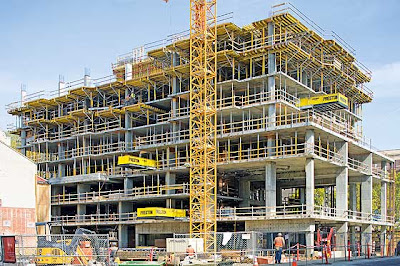
Industrialized Building System is an alternative approach of construction that will definitely change the scenario of the current local construction industry towards a systematically approach of mass production of construction materials. Prefabricated components of buildings which are conceived, planned, fabricated from factories will be transported and erected on site. With this method, the process would involve planning; management and sustained improvement of the production process to eliminate waste and ensure the right components are produced and delivered at the right time, in the right order and without defect. In this respect, the construction industry has a great deal to learn from the manufacturing sectors that have long been emphasizing on quality and minimising defects. IBS will definitely among others reduce unskilled workers in the country, less wastage, less volume of building materials, increased site cleanliness and better quality control.


Material used in IBS System ;

1) Pre-cast Concrete Framing, Panel and Box systems
2) Steel Formwork Systems
3) Steel Framing Systems
4) Prefabricated Timber Framing Systems
5) Block Work Systems

Benefit using IBS System
The Industrialised Building Systems (IBS) promises elevated levels of expertise throughout the industry, from manufacturers, installers, engineers, planners, designers, and developers. The benefits of IBS are numerous and far reaching. Reduced construction time, better site management, reduced wastage are but a few of these benefits, that will ultimately produce better products for the population

IBS project in Malaysia.
IBS is not new in Malaysia and have been around since the early sixties. The first pilot project was initiated by the Government and it was along Jalan Pekeliling which involved 3,000 units of low cost flats and 40 shop lots. However, developments in IBS after that failed to gain support from the industry and consumers. From a survey done by CIDB on 2003, it was found that the percentage usage of IBS in the local construction industry is only at a mere 15%. However, several major world class developers in Malaysia have used some percentage of IBS in their projects. Several projects that use IBS can be seen as follows. 

  • KLIA
  • Government Quarters in Putrajaya
  • Petronas Twin Towers
  • KL Central 
Among the reasons that have made IBS not very popular with the developers would be the abundance of cheap foreign labours in the country. Currently there are about 250,000 workers in the construction industry. The Government’s effort to reduce the foreign workers to not more than 15 percent of the country’s labour force in the next five years would be an impetus for the local developers to use IBS. By using a superior construction technology that requires highly skilled workers, the dependence on foreign workers would significantly be reduced.

Wednesday, June 9, 2010

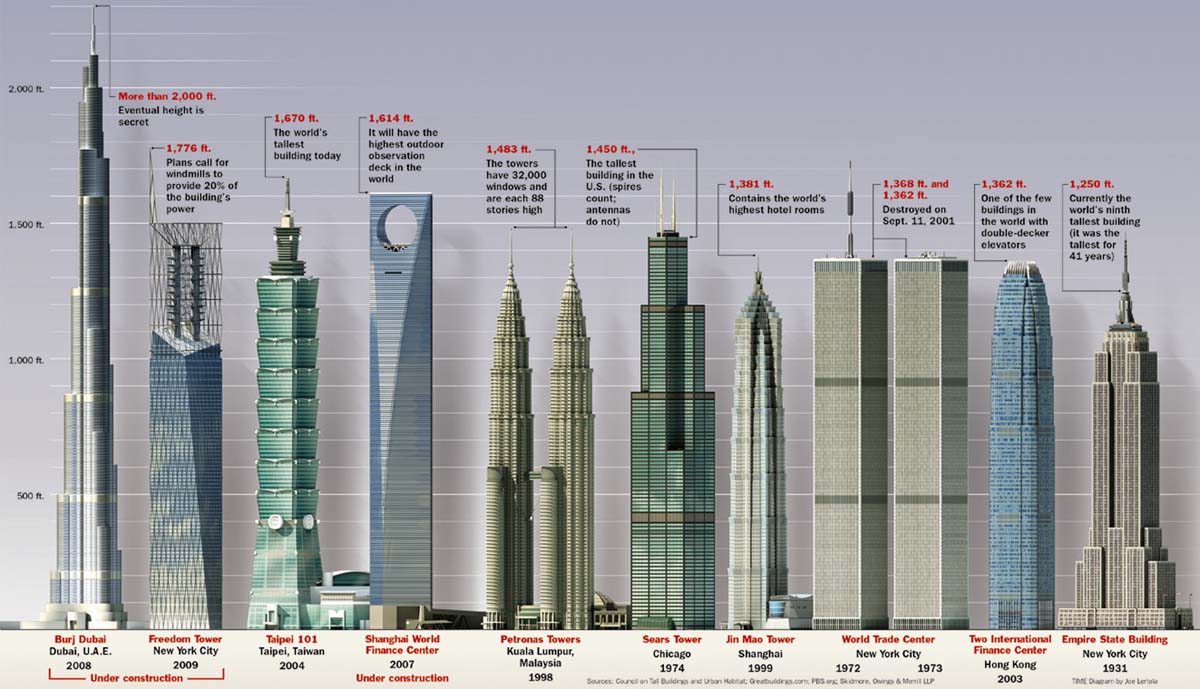
Tallest Buildings In The World

The Tallest Buildings in the World
Click Image for Larger View


When speaking of the tallest buildings in the world, it is important to specify exactly what is being measured. Listers must decide if the building is to be measured from sidewalk level or below, whether or not TV towers or masts are included, and whether an antenna, flagpole, or spire should count. A building is considered to differ from a tower in its primary use, being designed for residential, business, manufacturing, or mixed use, whereas a tower is not.